
Categories
Real Estate Knowledge, Lifestyle, Home Ownership, St. Louis Real EstatePublished July 2, 2026
Downtown Chesterfield: The Shift Toward Walkable Suburban Living

Downtown Chesterfield: The Shift Toward Walkable Suburban Living
For decades, the American dream followed a predictable blueprint: a quiet suburban home, a sprawling green lawn, and a mandatory 30-minute commute by car just to buy a gallon of milk. But a quiet revolution is taking over the suburbs. What happens when the generation that fled the concrete jungle suddenly demands the urban walkability they left behind—without sacrificing the safety and space of the suburbs?
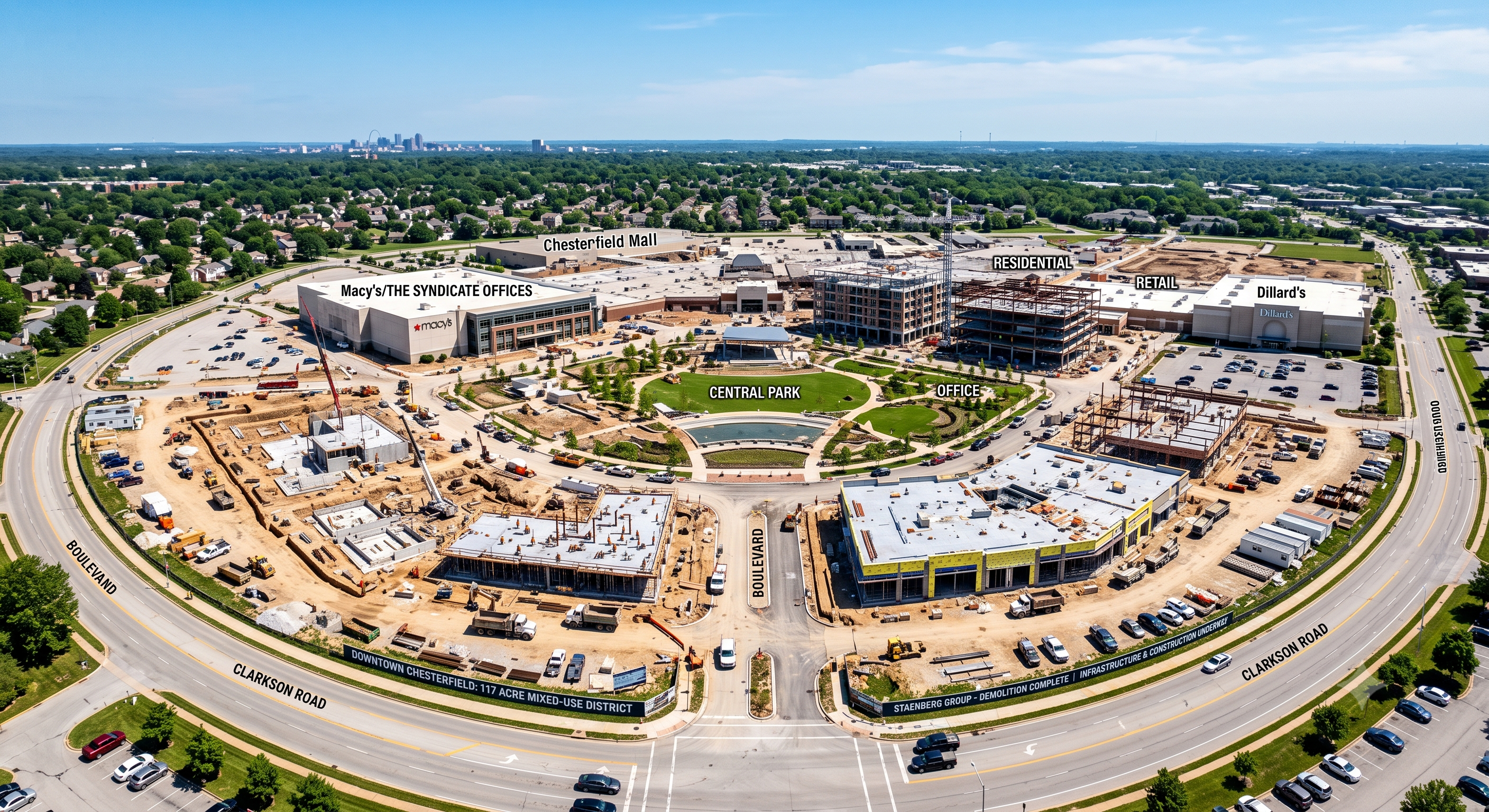
Look no further than Chesterfield, Missouri. In a masterclass of modern urban design, this iconic St. Louis suburb is pulling off the ultimate architectural plot twist: tearing down its massive 117-acre traditional indoor mall to build a multi-billion-dollar, pedestrian-first "city within a city."
Welcome to the era of Downtown Chesterfield, the blueprint for the new walkable suburb.
The Death of the "Car is King" Mentality
Suburbs were originally engineered for automobiles. Strip malls, giant asphalt parking lots, and multi-lane highways defined the landscape. But a massive cultural shift has been brewing.
Modern residents—from young professionals to downsizing empty-nesters—increasingly share the same priority: convenience without the congestion. They want a 10-minute neighborhood where work, dining, grocery shopping, and recreation are accessible on foot.
Instead of moving back to dense urban cores, communities are bringing the urban core to the suburbs.
Inside the $2 Billion Transformation
The redevelopment of the former Chesterfield Mall site isn’t just a facelift; it’s an entire ecosystem overhaul. Led by The Staenberg Group, infrastructure work is aggressively underway to transform a sea of dead retail space into a vibrant civic heart.
| Feature | The Vision for Downtown Chesterfield |
| The Footprint | 117 acres of highly integrated mixed-use zoning. |
| Residential Mass | Plans for roughly 2,700 residential units (apartments and condos) putting built-in foot traffic at the center. |
| The Green Anchor | A massive 3.3-acre signature public park acting as the neighborhood's beating heart. |
| Pedestrian Loop | A 1.25-mile wide-format pathway system explicitly prioritizing people over cars. |
By saving existing structures like the old Macy’s building for creative office spaces and high-end fitness facilities, the development bypasses the superficial "lifestyle center" vibe. Instead, it builds a resilient, multi-generational hub.
Why this works: True walkability requires a balanced mix. When retail softs, office spaces and residential neighborhoods keep a community alive. Downtown Chesterfield is aiming for a self-sustaining ecosystem where you can live your entire week without sitting in traffic.
Why "Suburban Downtowns" Are the Future of Real Estate
Chesterfield isn't alone in this endeavor, but its sheer scale makes it a crucial regional experiment. Suburban downtowns represent the future of real estate for three key reasons:
- Economic Resilience: Blending residential towers with street-level retail, corporate headquarters, and hospitality creates a continuous stream of economic activity.
- Environmental Harmony: Dedicating over 25% of the land to public plazas, rain gardens, and trails reduces the traditional suburban heat island effect and promotes sustainable, local living.
- Authentic Connectivity: It solves the hidden crisis of suburban isolation by providing open public squares where neighbors actually interact face-to-face.
Bottom Line: A Legacy in the Making
The standard suburban sprawl is officially dating itself. Projects like Downtown Chesterfield prove that density doesn't have to mean overcrowding, and the suburbs don't have to mean driving everywhere.
As the grading and utility work pave the way for vertical construction by 2027, all eyes are on this corner of West St. Louis County. It is proof positive that the best way to predict the future of suburban living is to build it from the ground up—one walkable block at a time.
What do you think?
Would you trade a massive suburban driveway for a luxury condo sitting right on a 3-acre park? Let’s talk in the comments below!
or another way